Upcoming Events: Tissue Culture Workshop Oct 3 @ 11 am / Succulent Pumpkin Workshop Oct 4 @ 2 pm / Plant Swap Oct. 10 @ 10 am / Stained Glass Workshop Sunday Oct. 11th @ 2 pm
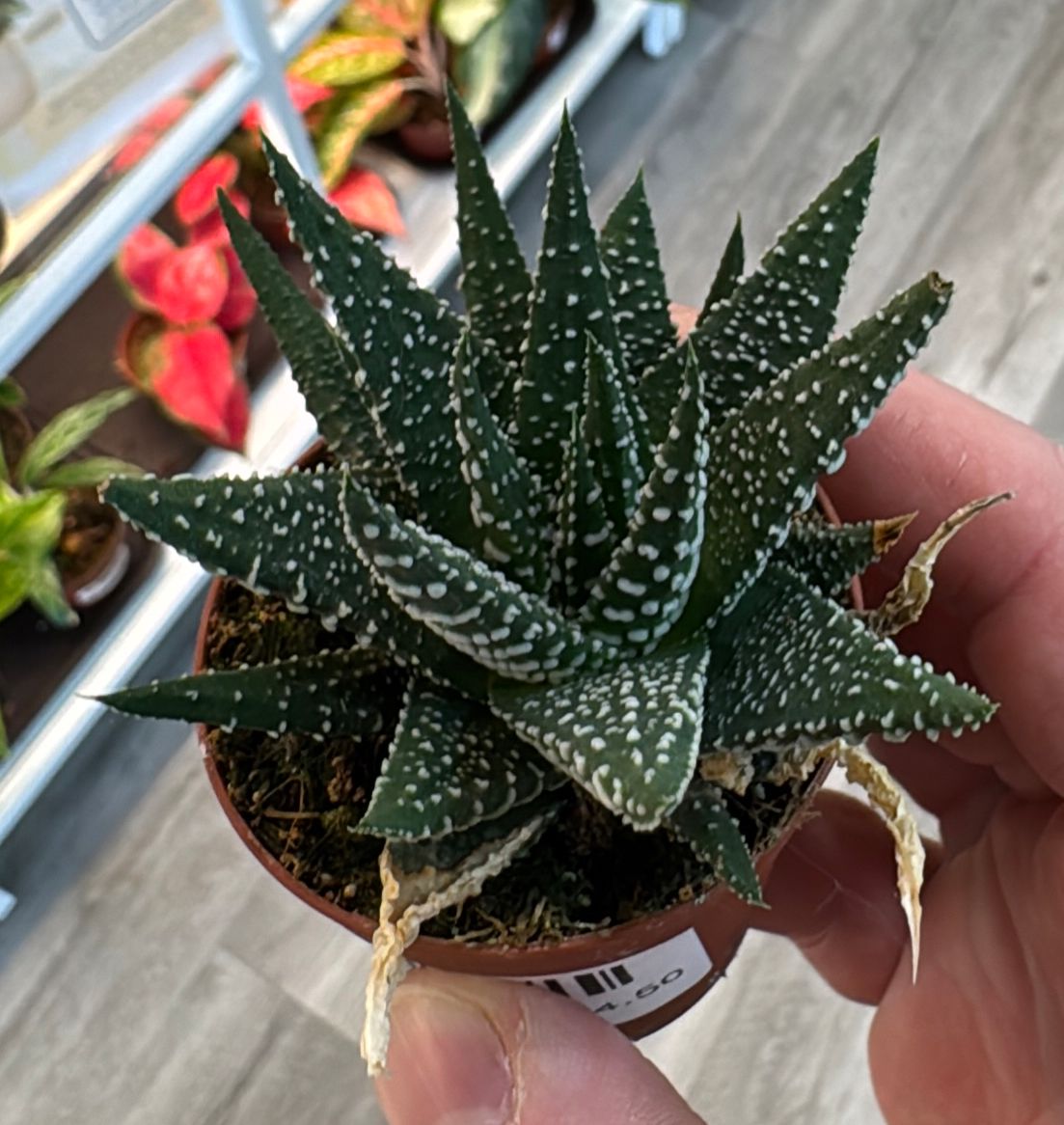
2" Haworthia Zebra
$4.50
Buy and save
Buy and earn $0.22 Loyalty for your next purchase
Loyalty is a discount program that lets you buy products and earn points to redeem on your next purchase. Your Loyalty balance is updated when you pay online or in-store. The Loyalty amount shown on this page can be recalculated at the checkout.
In stock: 14 available
2" Haworthia Zebra
Product Details
Brand: Plant
Haworthia Zebra
Haworthia Zebra is a compact succulent prized for its dark green, pointed leaves covered with raised white bands or bumps that create a bold striped appearance. Its stiff leaves grow in an attractive rosette, giving the plant a clean, architectural shape. Small size, slow growth, and tolerance of typical indoor conditions make it an excellent succulent for windowsills, desktops, and small-space plant collections.
The plant commonly called Zebra Haworthia or Zebra Plant is usually Haworthiopsis attenuata, formerly classified as Haworthia attenuata. It is native to South Africa. It is frequently confused with the closely related Haworthiopsis fasciata, which has a similar striped appearance. Haworthiopsis attenuata generally has raised white markings on both the inner and outer surfaces of its leaves, while H. fasciata typically has smoother inner leaf surfaces.
Care
Haworthia Zebra does best in bright, indirect light with some gentle direct sunlight. It generally requires less intense sunlight than many desert cacti and can tolerate medium light indoors. Avoid prolonged harsh afternoon sun, which can scorch or stress the foliage.
Allow the potting mix to dry completely or almost completely between waterings, then water thoroughly and allow all excess water to drain. Its thick leaves store moisture, making overwatering a greater concern than occasional dryness. Reduce watering during cooler months or periods of slower growth.
Use a very well-draining, gritty succulent potting mix in a container with drainage. Adding pumice, perlite, lava rock, coarse sand, or other mineral amendments can improve drainage and airflow around the roots. Avoid dense soil that remains wet for extended periods.
Haworthia Zebra prefers mild to warm temperatures and low to moderate humidity with good airflow. Typical household temperatures are generally suitable. Protect it from prolonged freezing temperatures and from excessively hot conditions combined with intense direct sunlight.
This succulent develops a slow-growing, compact rosette habit and commonly produces offsets or “pups” around the base. These can be left attached to create an increasingly dense cluster or separated once established to produce additional plants. Mature specimens may also produce long, slender flower stalks carrying small pale flowers.
Pet Safety
Haworthia Zebra is generally considered pet-friendly and non-toxic to cats and dogs. As with any plant, consuming a large amount of foliage may still cause mild digestive upset, so discouraging pets from chewing on the plant is recommended.
Powered by Lightspeed
Display prices in:USD